

At first glance, specifying materials with a high Solar Reflectance Index (SRI) seems like a straightforward way to design cooler buildings. After all, SRI measures a surface’s ability to reflect solar radiation and emit absorbed heat. Higher values are often equated with better thermal performance. But here’s the catch: a high SRI alone does not guarantee a cool building.
SRI only tells us how well a material reflects sunlight and releases heat. In real life, how cool a building feels depends on many other factors, too. Things like the building’s insulation, materials used (thermal mass), airflow and ventilation, roof design, surrounding environment (like city heat), and even how people use the space all play a big role. If architects focus only on SRI, they might miss better ways to improve comfort and energy efficiency.
In this blog, we will explain why a high SRI alone doesn’t guarantee a cooler building. It also highlights the important design factors that should be considered along with material choice. By understanding this, architects can design buildings that are not just good on paper, but actually comfortable, energy-efficient, and suited to the climate.
What Architects Need to Know
Relying on SRI as a primary design metric can lead to disappointing real-world performance. Architects need to understand the limitations of SRI and how it fits into a broader thermal strategy. Here are the things an architect needs to know:
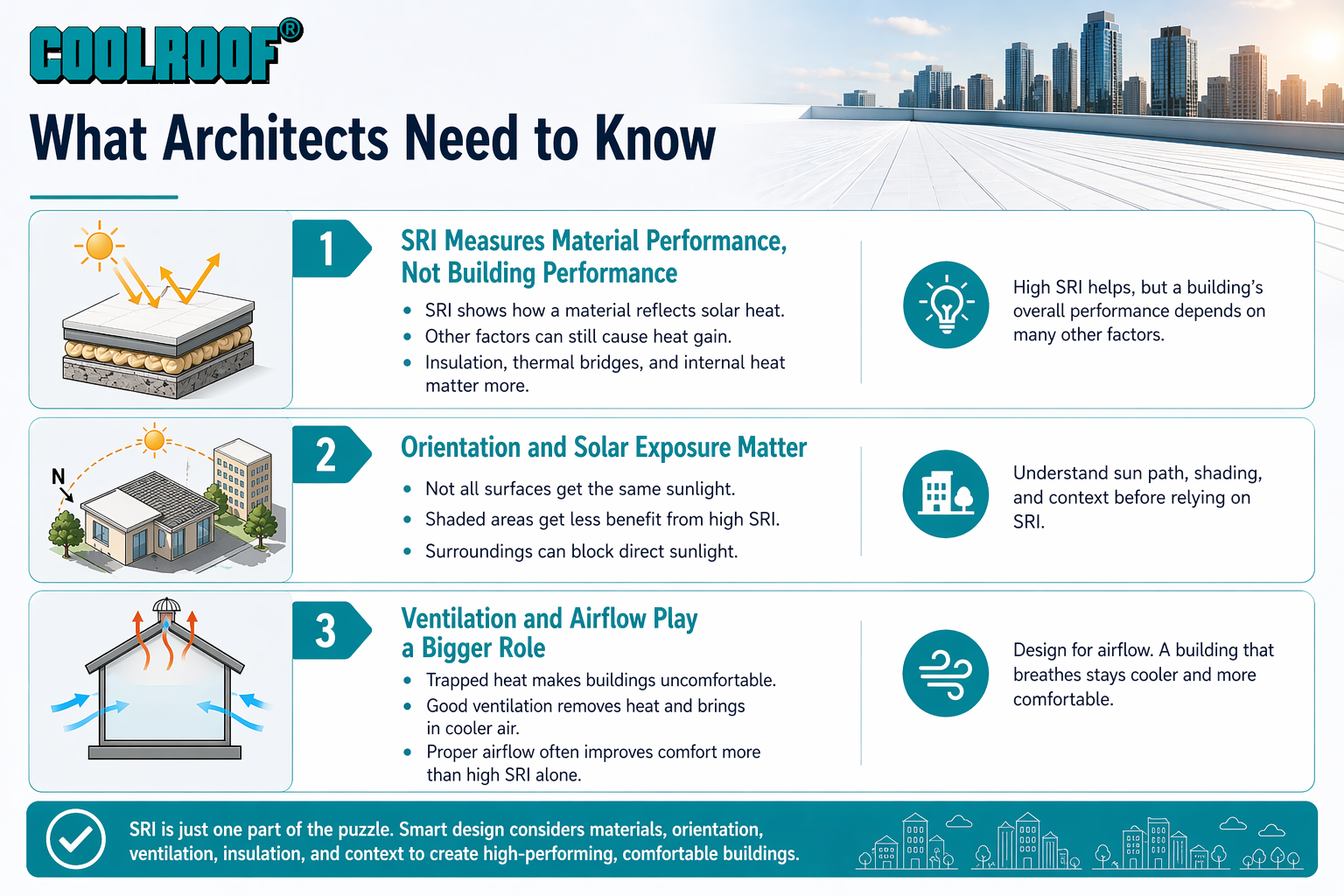
SRI Measures Material Performance, Not Building Performance
SRI (Solar Reflectance Index) only tells us how a surface material, like a roof tile or coating, reacts to sunlight. It measures how well that material reflects heat and releases it back into the air. A building is made up of many layers and systems working together. So even if you choose a roof material with a high SRI (meaning it reflects a lot of heat), other factors can still cause the building to get warm:
- If there is poor insulation under the roof, heat can still pass inside.
- Thermal bridging (gaps or connections where heat easily travels, like metal structures) can reduce the benefit of reflective materials.
- Heat generated inside the building from people, lights, computers, or machines can still make the space uncomfortable, regardless of the roof’s SRI.
Orientation and Solar Exposure Matter
Not every part of a building gets the same amount of sunlight. Some areas stay shaded most of the day, which reduces the impact of reflective materials. North-facing walls, shaded roofs, or areas covered by nearby buildings or trees may not receive enough direct sunlight for SRI to make a difference.
- Shaded surfaces don’t benefit much from high SRI
- Surroundings like trees or nearby structures can block sunlight
Ventilation and Airflow Play a Bigger Role
Even if a building uses reflective materials like high-SRI roofs, it can still feel hot inside if the heat has nowhere to go. When air gets trapped, it builds up temperature and makes the space uncomfortable. That’s why ventilation and airflow are so important. They help carry heat out and bring in cooler air. In many cases, proper airflow can improve comfort more than just choosing a reflective surface. A well-ventilated building “breathes,” while a poorly ventilated one traps heat like a closed box.
Here’s how airflow makes a difference:
- Roof spaces (like attics) can become extremely hot during the day. Without ventilation, this heat gets trapped and slowly moves into the rooms below. Proper vents allow hot air to escape.
- Walls and façades should not completely block heat. Ventilated façade systems or small air gaps help release built-up heat instead of letting it pass indoors.
- Cross ventilation inside the building, where air enters from one side and exits from another, creates a natural cooling effect. This helps remove warm air and improves indoor comfort without extra energy use.
- Openings like windows, vents, and shafts also play a key role in maintaining continuous airflow, especially in warmer climates.
Other Aspects That Impact The Building Temperature
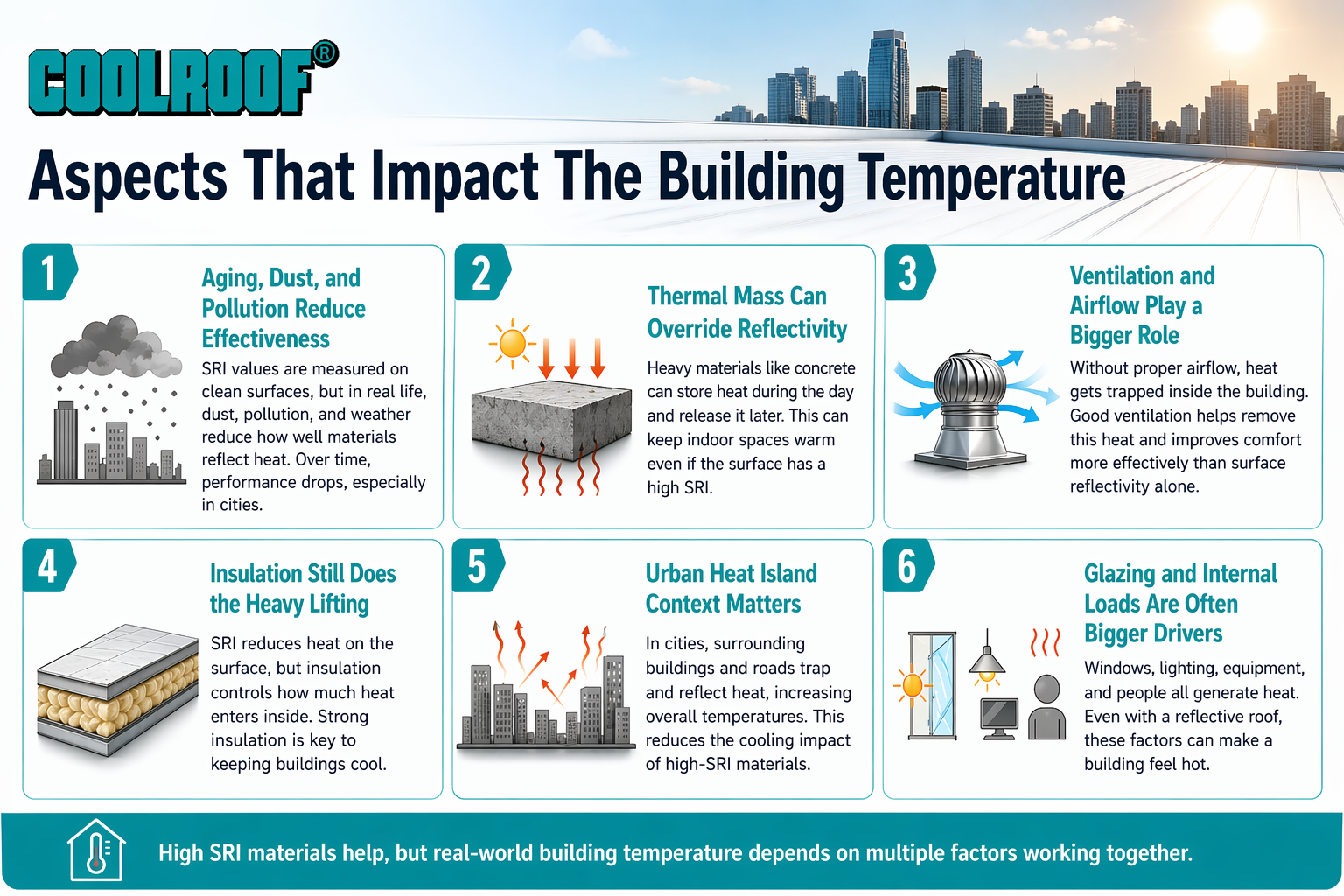
Aging, Dust, and Pollution Reduce Effectiveness – SRI values are measured on clean surfaces, but in real life, dust, pollution, and weather reduce how well materials reflect heat. Over time, performance drops, especially in cities.
Thermal Mass Can Override Reflectivity – Heavy materials like concrete can store heat during the day and release it later. This can keep indoor spaces warm even if the surface has a high SRI.
Ventilation and Airflow Play a Bigger Role – Without proper airflow, heat gets trapped inside the building. Good ventilation helps remove this heat and improves comfort more effectively than surface reflectivity alone.
Insulation Still Does the Heavy Lifting – SRI reduces heat on the surface, but insulation controls how much heat enters inside. Strong insulation is key to keeping buildings cool.
Urban Heat Island Context Matters – In cities, surrounding buildings and roads trap and reflect heat, increasing overall temperatures. This reduces the cooling impact of high-SRI materials.
Glazing and Internal Loads Are Often Bigger Drivers – Windows, lighting, equipment, and people all generate heat. Even with a reflective roof, these factors can make a building feel hot.
Material Performance vs. Building Performance
| Aspect | Material Performance (SRI Focus) | Building Performance (Real Conditions) |
| What it Measures | How a surface (roof, coating, tile) reflects sunlight and releases heat under test conditions | How the entire building behaves in real-life conditions, including heat flow, comfort, and energy use |
| Scope | Limited to a single material or surface | Covers the whole building system—roof, walls, insulation, airflow, and usage |
| Testing Environment | Measured in controlled, clean lab conditions | Affected by real-world factors like weather, dust, pollution, and surroundings |
| Heat Control | Reduces heat absorption at the surface level | Depends on insulation, ventilation, thermal mass, and design strategies |
| Impact of Insulation | Not considered in the SRI value | Poor insulation can allow heat to enter even with high-SRI materials |
| Thermal Bridging | Ignored in the material rating | Heat can pass through structural gaps, reducing overall performance |
| Internal Heat Sources | Not included | Heat from lights, equipment, and people directly affects indoor comfort |
| Sunlight Exposure | Assumes direct sunlight for best performance | Varies based on building orientation, shading, and surroundings |
| Long-Term Performance | Based on clean, new surface conditions | Changes over time due to dust, ageing, and maintenance |
| Comfort Outcome | Does not guarantee indoor comfort | Determines how cool, comfortable, and energy-efficient the space actually is |
| Decision Making | Helps in selecting materials | Requires a holistic design approach combining multiple factors |
Final Words
A high SRI can definitely help reduce heat on building surfaces, but it should never be the only factor guiding design decisions. Real building comfort depends on a combination of insulation, ventilation, material properties, orientation, and surrounding conditions. Ignoring these can lead to spaces that still feel hot despite using “cool” materials. Architects and designers should focus on a holistic approach, where SRI is just one part of a larger strategy. By balancing multiple design elements, it is possible to create buildings that are not only energy-efficient but also truly comfortable for occupants. In the end, good design is about how a building performs in real life – not just how it scores on paper.